We recently released a podcast episode, titled “How to Select the Right Weights and Exercises for You.”
During that podcast, Chris and I talked about a tool called Reps in Reserve. It’s a guide for dialing in your weight selection based on how many reps you could have done with the weight that you chose. For example, if the program calls for 5 reps during the set with 3 Reps in Reserve (RIR), you’ll choose a weight that you could do for 8 reps with good form. RIR is an intelligent way to dial in our weight selection because it does a few things for us.
First, it keeps us from using too much weight. There’s a common misconception that you must push yourself to failure, or near failure, with each set to get stronger and build muscle. That ain’t true, dawg. Yes, you need to lift an appreciable amount of weight to get stronger. But you don’t need to max out every set. Hell, you don’t need to ever max out to get stronger. Your body supercompensates to the demands you give it. That means if you lift 85 pounds, your body adapts to lift more than 85 pounds so that it doesn’t cost as many resources the next time you encounter that weight. But you have to leave gas in the tank for the adaptation to work. If you’re constantly taxing all of your resources, your body won’t have the reserves necessary to recover and supercompensate.
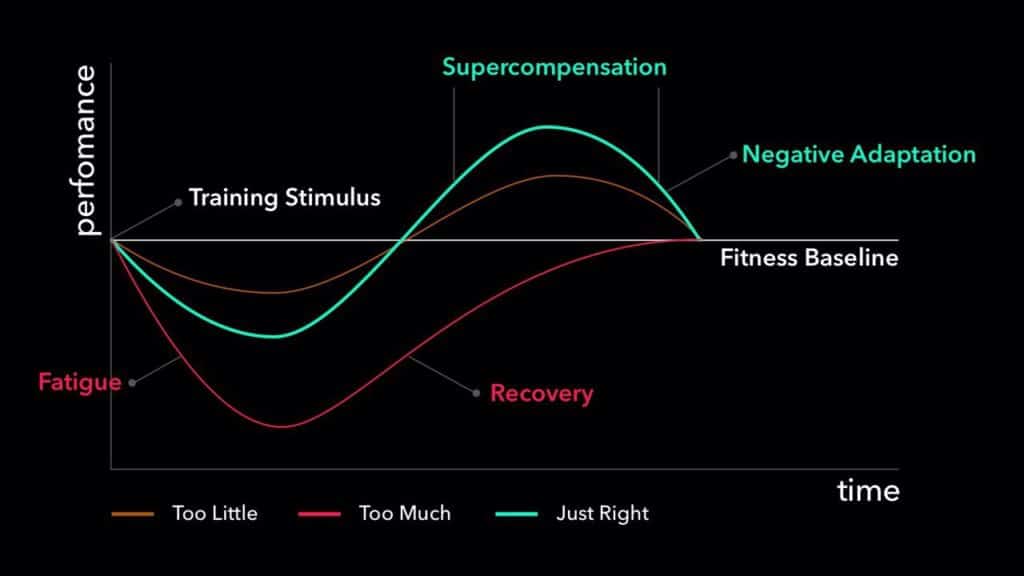
Second, it keeps us from using too little weight. There are some among us that bias toward the lighter side of weight selection. And while we don’t want to max out every set or every workout, we do need enough weight to make our body pay attention. If the program calls for sets of 5 and you choose a weight that you could have done for 15 reps, you’re not using enough weight. You’ll be slow to gain strength because your body won’t recognize the lift as a threat worth adapting to. RIR ensures that we’re giving ourselves an appropriate level of challenge.
Third, it helps us maintain good form. This goes hand in hand with not using too much weight. Setting the RIR limit gives us a bumper that keeps us from pushing up against our technique limits. If you leave a few RIR with maintaining good form as a qualifier, it’s unlikely that you’ll walk yourself into a potentially injurious situation.
Now that we know what RIR does for us, let’s talk about how to use it.
RIR: A Quick, Dirty Practical Guide
How do you know you’ve chosen a weight that leaves the correct number of reps in reserve?
Don’t overthink it. There is some trial and error involved. And RIR is a moving target. Before we get practical, let’s layer on a bit more understanding.
RIR can change from day-to-day and week-to-week depending on a few factors. Those factors include: Your mood, your recovery status, your nutritional status, etc. So, one day you might use 200 pounds for a set of 5 with 3 RIR, and the next week you might do that same set with only 190 pounds. RIR is a moving target based on where you are that day. Now, best case scenario is that you get stronger from week to week and your RIR follows suit. But progress typically isn’t linear. It often takes weeks or months to show lasting progress, especially if you have a lot of training experience.

Okay. Let’s get practical.
If you’ve never used RIR before, start by taking a guess. Grab a weight, or load a weight on the bar, and try a few reps. Then, ask yourself, “How many reps could I have done with that weight?” Be honest. If it felt like you could have done a ton more with that weight, grab a heavier one. If it felt too heavy to leave the appropriate reps in reserve, go down. Once you’ve hit your Goldilocks weight, do your sets.
This takes some practice. It’s okay if you don’t nail it with the first try, or even the first few tries. Training is a long game and RIR is a skill worth building that serves you long-term. Grab some weights; give it a try; pay attention. You’ll get it.
Also, track your weights. Knowing what you lifted for a given number of reps allows you to set a baseline. Jot down a note or two beside the weight so you know how it felt. The next time you do that exercise you’ll be able to recall what you did last time and compare it to how you currently feel. You might go up; you might go down; you might use the same weight.

What matters is your inner dialogue. Can you leave the appropriate number of reps in reserve with that weight right now? If yes, proceed. If not, go up or down according to the current situation.
It’s also important to check in with your coach. Ask them to watch you do some reps with a given weight and tell you whether or not it was appropriate based on the prescribed RIR. Sometimes what feels a little heavy actually isn’t. Your nervous system is simply waking up and you’re moving the weight faster than you realize. A coach will see this and guide you toward a weight that hits the RIR prescription.
RIR is a simple tool that guides you through intelligent weight selection. It helps you gain strength; it helps you use good form; and it helps you to choose weights in the Goldilocks range. Remember that RIR is a moving target that requires trial and error to get it right. So, grab some weights and give it a shot.
You might also like:
- HOW TO PROGRESS YOUR WEIGHTS DURING A STRENGTH PROGRAM
- WHY YOU’RE DOING WHAT YOU’RE DOING: FEBRUARY 2023 PROGRAM BLOG
- HOW (AND WHY) OUR YEAR-LONG TRAINING PLAN WORKS
- WHY WE TEST AR BEYOND STRENGTH
- TIPS FOR COMPETING WITH YOURSELF IN THE GYM
- HOW TO SET GOALS FOR 2023
- HOW MANY REPS SHOULD YOU DO? (Spoiler alert, it matters in more ways than you think)
- HOW TO KEEP EXERCISING WHILE TRAVELING
- LET’S SEE HOW GREAT I CAN DO THIS
- HOW TO RECOVER FROM YOUR WORKOUTS
- WHICH TYPE OF CONDITIONING IS BEST FOR FAT LOSS
- FITNESS: THE INFINITE GAME