Lots of folks are hooked up to wearables and fitness trackers nowadays. I’m one of them. So are many of the Beyond Strength members. People are sporting Oura rings and Whoop bands. They’re checking their HRV with Morpheus and monitoring their recovery on their Garmin watches. The question is: how is all of this technology and tracking affecting us? Follow-up question – is that effect good? As it usually goes, the devil is in the details. Yes, there’s a place in your life for wearables should you choose to use them. But they can really mess with your psyche and your training if you’re not careful to create a degree of separation from them.
We’ll talk about how to create that degree of separation, but we’ll start with a chat on what happens when you don’t.
The Hawthorne Effect
While it sounds like a Midwest emo band from the early 2000s, the Hawthorne Effect is a noted change in human behavior in response to the awareness of being observed. (Definition paraphrased from Wikipedia.) Essentially, you behave differently when you know you’re being watched. For example, churching up your food log and eating better than usual because you know a coach will review it.
The effect is also apparent in other ways. Let’s say you’re feeling just fine, but a friend comments that you look tired. Voila! You begin feeling tired even though just a bit ago you felt good. Wearables can (note: can) cause a similar effect. For example, you wake up and check your HRV and it tells you that you should feel like doo doo. Then you feel like doo doo. If it tells you that you should feel great, you’ll often feel great. Sometimes it’s the truth. But other times it is not. We have to learn to use our wearables so that they are useful without overly subjecting us to the Hawthorne Effect. We’ll cover a handful of ways to do that.
Take a Guess
The goal is to create a separation from the data our wearables give us by layering in objectivity. One strategy for doing this is guessing what your wearable will say before you look at it. This is a strategy that I’ve adopted and I use every day.
Instead of waking up and immediately checking your Whoop or Oura readout, pause and try to guess what it might say. Here’s how I do it:
I get up, take stock of how my body and my mind feel, go to the bathroom, continue to take stock, formulate how I feel, and then lie down to check my Oura and do my Morpheus recovery reading.
If how I feel coincides with what my Oura and Morpheus readouts say, I tend to follow the readouts. (Albeit after following the warm-up test – more on that later.)
But if I wake up feeling fine and the wearables tell me I should feel like shit, I tend to ignore the wearables, or at least take an appraisal by doing the warm-up test.
If the wearables tell me I should feel great and I don’t, I get a more accurate appraisal by doing the warm-up test.
This process trains you to get in tune with yourself while appropriately applying the data. As you employ it, you’ll get better at noting and predicting how different training days impact you and what to do based on how you feel and what the data tells you.
Warm-up Test
The warm-up test is simple. You see how you feel after you warm up. Sometimes I extend this into the first 15 or so minutes of the workout. If you feel good after warming up, go about your business as planned. If you don’t feel any better, bag the workout or decrease the volume, the intensity, or both.

Don’t Look
Chris uses this strategy. He doesn’t check his wearable readouts until after he trains, making him impervious to the day-to-day impact of the Hawthorne Effect. He can, however, check the data after training to see if how he felt while training coincided with what his Oura ring or other wearables tracked. This allows him to connect the dots between all of his stressors, training or otherwise, and get a full picture of training, life, stress, and recovery so he can adjust his training and other behaviors in the future.
Note from Chris: I use a morning check-in with myself during which I pay attention to how rested I feel, where my motivation to train is, and how I’m feeling in general. I then extend my self-assessment to the warm-up test and scale RIR and RPE in the gym as needed. And the same goes for BJJ, but I scale whether I’ll opt for sitting out more rolls than I have the opportunity to do. So why wear my Oura Ring? When things are feeling really off, I can look into the components in the next section. And lastly, I put the most stock in my trends that you’ll learn more about below…
Ignore The Scores
Here’s the deal: the scores your wearable gives you are arbitrary. Yes, your sleep score, your strain score, and whatever other score yours might give you. Don’t put a lot of stock in them, or ignore them altogether. Instead, look at the actual components. Look at your resting heart rate and compare it to your trends. Look at the actual breakdown of your sleep cycle. Look at your HRV. Yes, they use all of these pieces of data to comprise the score, but the score isn’t actually validated by anything. Review the individual pieces of data, don’t worry too much about what the scores say.
Check Trends
This is where our wearables are most useful. Look at your trends at the end of a week to see how the flow of a week affected you. Review your trends at the end of a month, or training phase, to see how the workouts affected you across time – and to see how stressors outside of the gym impacted you in combination with the workouts. Have a gander at the end of a training block to paint a full picture of how life and training went during the previous three months so you can modify your behaviors going forward.
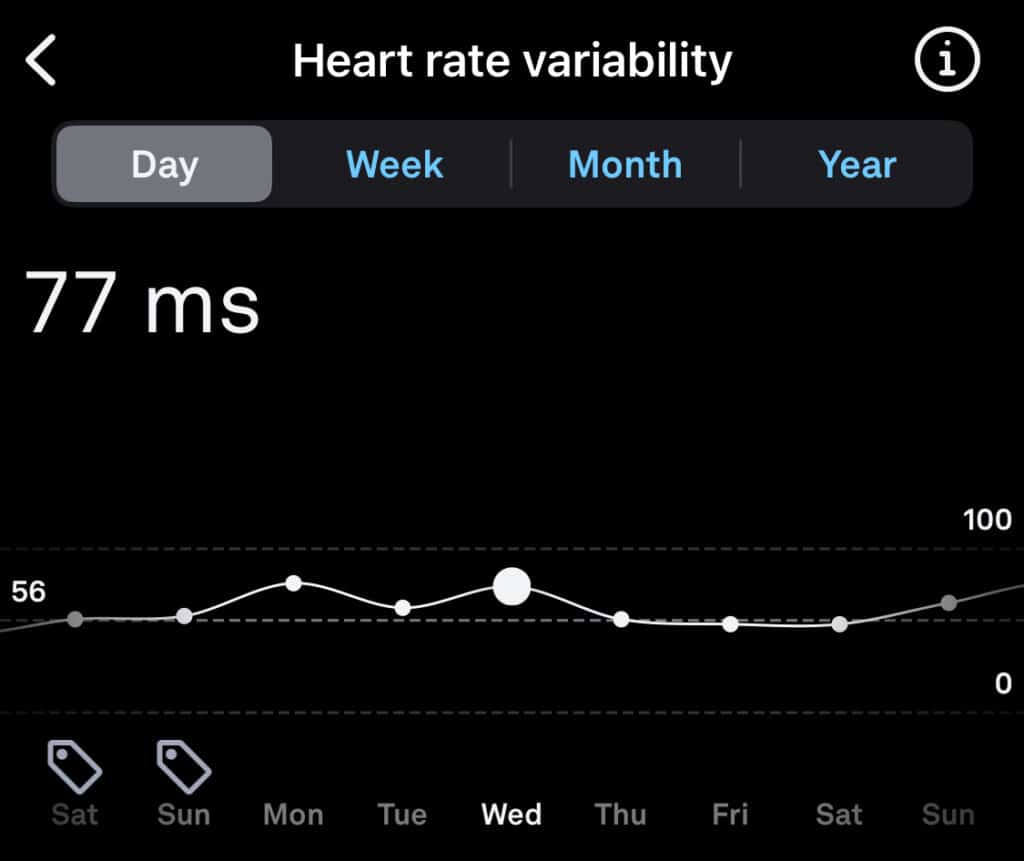
I think the end-of-the-week review is most useful. Things are fresher in your mind and you can make quicker adjustments. You can remember how a stressful day at work impacted your workout, your sleep, etc. Then you can make adjustments, or at least have awareness, for the next week. You can remember how you felt during a workout and note the data afterward. If you choose any of these to consistently use, I’d recommend the weekly review.
Take Breaks
One of the best ways to break your wearable’s hold on you is to take a break from it. Take a couple weeks off every few months. This space allows you to see it as a tool and not the absolute judge and jury that determines your behaviors. It’ll also give you time to get fully back in tune with your body without any external influence. You can take what you’ve learned from the data and apply it without being bombarded by it.
They’re Just Tools
Your wearable is just a tool. It is not the arbiter of your entire life. Use these methods to game your wearable so it doesn’t game you.
You might also like:
- HOW TO TRACK YOUR FITNESS PROGRESS
- MORPHEUS HEART RATE TRAINING: WHAT IT IS, WHY WE USE IT, AND HOW YOU CAN GET THE MOST OUT OF IT
- THE MOST IMPORTANT FITNESS VARIABLES: CONSISTENCY AND CONTINUITY
- HOW TO SET GOOD GOALS
- LIVE PHYSICALLY IN 2024
- 3 WAYS TO INCREASE MUSCLE MASS
- LIVE YOUR EVERDAY ADVENTURE
- WHEN CAN YOU EXPECT REAULTS FROM TRAINING?
- WHY STRENGTH SHOULD BE YOUR MAIN FOCUS DURING THE FALL AND WINTER
- YOU’RE NOT OLD, YOU’RE JUST ACTING LIKE IT
- BUILDING RESILIENCE: HOW MOBILITY TESTS ENHANCE YOUR STRENGTH TRAINING
- RELATIVE STRENGTH: WHAT IT IS, WHY WE TEST IT, AND HOW TO BUILD IT
- LIFE BEYOND YOUR GYM GOALS
- EUSTRESS TRAINING: HOW TO LIFT WEIGHTS AND MANAGE STRESS AT THE SAME TIME
- WANT TO MAKE PROGRESS? PUT SOMETHING HARD ON THE CALENDAR
- HOW TO RECOVER FROM YOUR WORKOUTS
- START NOW: WHY WAITING FOR THE PERFECT TIME IS THE WORST THING TO DO
- HOW (AND WHY) OUR YEAR-LONG TRAINING PLAN WORKS